
May 2026 Market Report

May 2026 Newsletter
Thurston Olsen Real Estate Group
Hey Friends!
Spring has officially arrived in Toronto, and with the nicer weather, you can feel the market starting to come back to life. More buyers are stepping out, listings are picking up, and that familiar spring energy is building again across the city.
What’s interesting right now is how different pockets of the market are creating opportunities in different ways. Some neighbourhoods and property types are seeing competition ramp back up, while others are still giving buyers a bit more room to breathe. It’s not one-size-fits-all, and that’s actually where the opportunity lies.
Think of it like patio season – Some spots are already buzzing, others you can still walk right into and grab a great table. The key is knowing where to look.
With momentum building and conditions starting to tighten, this is the kind of market where a smart plan can really pay off, whether you’re buying, selling, or just keeping a close eye on things.
Here’s your May 2026 Market Update. Let’s dive in.
The “Bank of Mom & Dad” Is Reshaping the Market
There’s a massive wave of wealth moving through Canada right now, and it’s starting to leave a real mark on the housing market. Experts estimate that over $1 trillion will be passed down from baby boomers to younger generations between 2023 and 2026, with a significant portion coming from real estate gains.
Here in Toronto, we’re seeing this play out in real time. More buyers (especially first-timers) are getting a financial boost from family, whether it’s help with a down payment or early inheritance. In fact, nearly 1 in 3 first-time buyers recently received support, with average gifts now north of $100K. That kind of backing can be the difference between sitting on the sidelines and actually getting into the market.
From a market perspective, it’s quietly adding fuel to demand. Buyers with support can act faster, compete more aggressively, and stretch a little further on price, particularly in entry-level and family-friendly segments. At the same time, it’s creating a wider gap between those who have access to that help and those navigating things on their own. And that’s where it gets interesting. This isn’t just a financial trend – it’s starting to shape who’s able to participate in the market, how competition plays out, and even what “affordability” looks like from one buyer to the next.
It raises a bigger question: how much is family support influencing today’s market, and where does that leave buyers going it alone?
We’re always curious what you’re seeing out there. Are more buyers in your circle getting a boost from family, or are you noticing the pressure from the other side of the table? Are you considering giving your children an early inheritance so that they can get into the market?
We’d love to hear from you!
What We Are Seeing From the Field
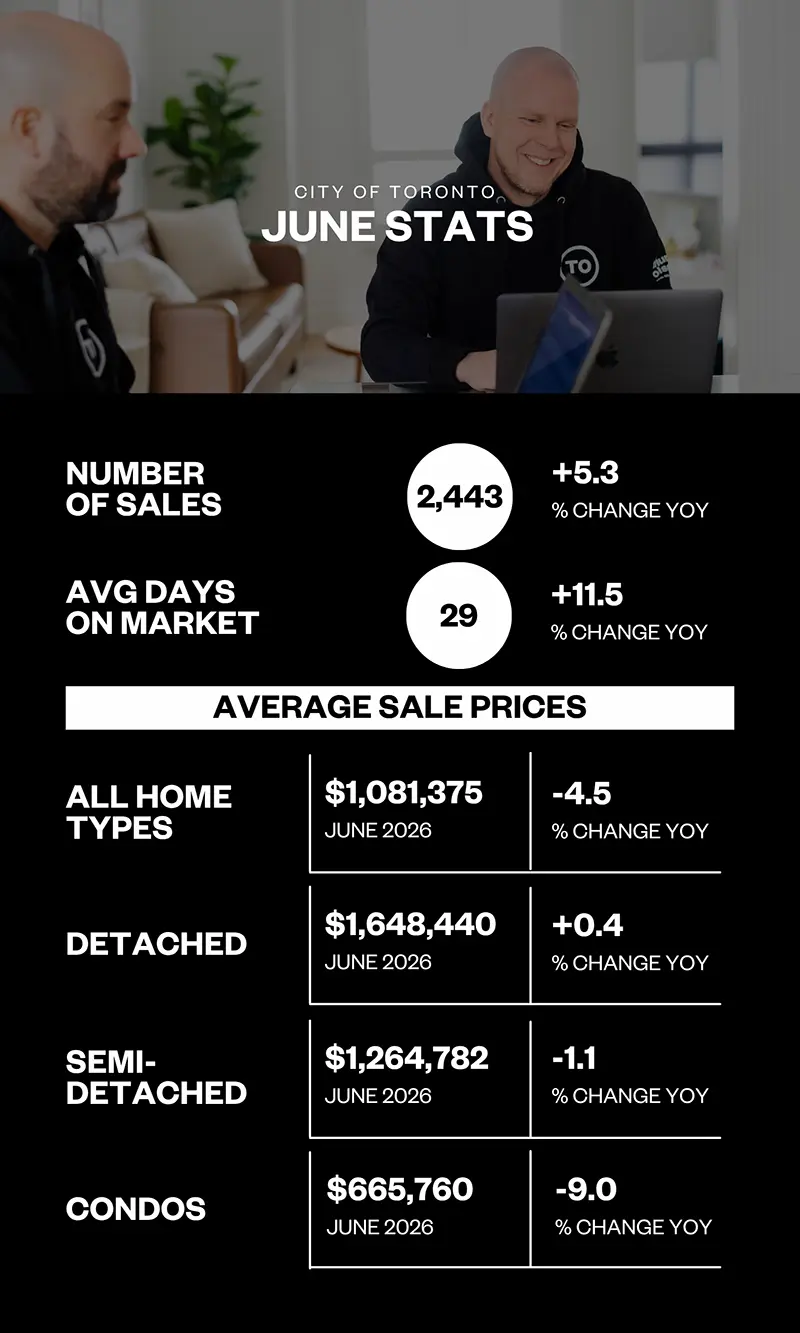
April brought a subtle but important shift in the GTA housing market. Sales were up 8.6% year-over-year, with 2,312 homes trading hands, while new listings dropped by 13.6%, pointing to a market that’s beginning to tighten as we move through the spring season.
Even with improving activity, buyers are still benefiting from relatively softer pricing, with the average home price sitting at $1,091,761, down 4.6% from last year.
With that said, prices have started to stabilize on a month-over-month basis, suggesting the window of opportunity may not stay open for much longer.
Lower borrowing costs and improved affordability have brought more buyers back into the market, but there’s still a significant amount of pent-up demand waiting on the sidelines. If listings remain constrained and confidence continues to build, we could see competition increase in the coming months, particularly for well-priced homes in desirable neighbourhoods.
Check out the April year-over-year stats below for more information on the current market.
If you would like statistics specific to your neighbourhood, an updated Comparative Market Analysis for your home, or help deciphering what the numbers could mean for you, please let us know and we would be happy to provide that for you.
Help Us, Help Others!
We’re incredibly thankful for the referrals you send our way. They make up a big part of our business. This year, on top of that usual support, we’re aiming to help 12 additional families with buying or selling in Toronto.
If anyone comes to mind who could use some guidance, we’d be honoured by an introduction. We promise to take great care of them (and make you look good.
Have a great month!
Chris and Ford
March 2026 Market Report

March 2026 Newsletter
Thurston Olsen Real Estate Group
Hey Friends!
March is when the Toronto market really starts to stretch its legs. The quiet pause of January fades, new listings begin to pop up, and buyers who spent the winter “just watching” suddenly start stepping into the game. You can almost feel the energy shifting across Toronto as we move closer to the spring market.
It’s also the time of year when some of the bigger conversations about housing in Toronto start bubbling up again. Development is one of them. Some people welcome the cranes on the skyline as a sign that our growing city is creating more homes. Others worry about the impact on neighbourhood character, traffic, and years of construction disruption. Like most things in real estate, there are thoughtful arguments on both sides.
What we do know is this: demand for housing in Toronto isn’t going anywhere. As the market slowly builds momentum, strategy, timing, and preparation are becoming more important than ever for buyers and sellers looking to make smart moves this year.
Here’s your March 2026 Market Update. Let’s dive in.
Toronto Development: Progress or Pain?
If you’ve lived in Toronto for more than five minutes, you’ve probably had this conversation.
“Why are they building another condo here?”
Or…
“Where else are people supposed to live?”
The truth? Both sides have valid points.
The Case For Development
Toronto continues to grow. New families, newcomers, young professionals, downsizers, and they all need housing. Without new supply, prices can climb quickly, making it harder for the next generation to put down roots.
New development can also bring:
- Increased housing options (condos, purpose-built rentals, townhomes)
- Revitalized streetscapes and infrastructure upgrades
- New retail, restaurants, and amenities
- Long-term property value growth in evolving neighbourhoods
Growth, when done well, can mean vibrancy. Think improved transit, better walkability, and more complete communities. Cities either grow… or they slowly fade. Toronto clearly isn’t choosing the second option.
The Case Against Development
On the flip side, change isn’t always comfortable.
Residents often worry about:
- Increased traffic and congestion
- Strain on schools, parks, and transit
- Years of construction noise and disruption
- Loss of neighbourhood character
For homeowners who moved in for tree-lined streets and a certain “feel,” a 40-storey tower next door can feel like a shock to the system. Development can sometimes outpace infrastructure planning, which is where frustration tends to boil over.
The Real Conversation
This isn’t really about “pro” versus “anti” development. It’s about balance.
How do we add housing without overwhelming communities?
How do we protect neighbourhood character while still making room for the next generation?
How do we plan smarter so infrastructure keeps up with growth?
Toronto’s challenge isn’t whether to grow, it’s how to grow well.
And whether you love cranes on the skyline or wish they’d take a holiday, the reality is that development will continue shaping our city. The key is thoughtful planning, strong community input, and policies that aim for long-term livability.
So… Where Do You Stand?
Are you in the “build more homes yesterday” camp?
Or the “let’s protect the neighbourhood feel” camp?
Maybe you’re somewhere in the middle – supportive of growth, but only if it’s done thoughtfully.
We’d genuinely love to hear your take.
Hit reply and let us know:
- Is there a development near you that you’re excited about?
- Or one that makes you shake your head every time you drive by?
- Do you think Toronto is growing the right way?
These conversations matter. Development impacts property values, rental demand, neighbourhood character, and long-term investment potential….whether we’re talking about a condo downtown or a family home in the core.
Your perspective helps us better understand what local families are thinking, which ultimately helps us serve you (and others) at a higher level.
Looking forward to hearing your thoughts, we read every reply.
What We Are Seeing From the Field
The latest numbers from Toronto Regional Real Estate Board suggest the market is tightening, but maybe not in the way many people expected.
In February, there were 1,491 home sales across Toronto, about 3% lower than this time last year. At first glance that might sound like the market is slowing, but the bigger story is actually happening on the supply side.
New listings dropped roughly 13% year-over-year, meaning fewer homes are coming to market. When listings fall faster than sales, it naturally starts tightening conditions and can increase competition among buyers over time.
Right now, many buyers appear to be taking a “wait and see” approach – watching prices closely and hoping for stability before jumping in. At the same time, industry estimates suggest more than 100,000 potential buyers are sitting on the sidelines, waiting for the right moment.
Prices have adjusted over the past year as well. The average Toronto home price in February was $1,019,144, roughly 6% lower than a year ago.
What does this mean in practical terms?
If listing inventory continues to remain tight heading into the spring market, the combination of limited supply and pent-up buyer demand could bring more competition back into the market, particularly in desirable neighbourhoods.
In other words: the spring market may end up being less about how many buyers are out there and more about how many homes actually come up for sale.
Check out the February year-over-year stats below for more information on the current market.
If you would like statistics specific to your neighbourhood, an updated Comparative Market Analysis for your home, or help deciphering what the numbers could mean for you, please let us know and we would be happy to provide that for you.

Help Us, Help Others!
We’re incredibly thankful for the referrals you send our way. They make up a big part of our business. This year, on top of that usual support, we’re aiming to help 12 additional families with buying or selling in Toronto.
If anyone comes to mind who could use some guidance, we’d be honoured by an introduction. We promise to take great care of them (and make you look good.
Have a great month!
Chris and Ford
May 2026 Market Report

May 2026 Newsletter
Thurston Olsen Real Estate Group
Hey Friends!
Spring has officially arrived in Toronto, and with the nicer weather, you can feel the market starting to come back to life. More buyers are stepping out, listings are picking up, and that familiar spring energy is building again across the city.
What’s interesting right now is how different pockets of the market are creating opportunities in different ways. Some neighbourhoods and property types are seeing competition ramp back up, while others are still giving buyers a bit more room to breathe. It’s not one-size-fits-all, and that’s actually where the opportunity lies.
Think of it like patio season – Some spots are already buzzing, others you can still walk right into and grab a great table. The key is knowing where to look.
With momentum building and conditions starting to tighten, this is the kind of market where a smart plan can really pay off, whether you’re buying, selling, or just keeping a close eye on things.
Here’s your May 2026 Market Update. Let’s dive in.
The “Bank of Mom & Dad” Is Reshaping the Market
There’s a massive wave of wealth moving through Canada right now, and it’s starting to leave a real mark on the housing market. Experts estimate that over $1 trillion will be passed down from baby boomers to younger generations between 2023 and 2026, with a significant portion coming from real estate gains.
Here in Toronto, we’re seeing this play out in real time. More buyers (especially first-timers) are getting a financial boost from family, whether it’s help with a down payment or early inheritance. In fact, nearly 1 in 3 first-time buyers recently received support, with average gifts now north of $100K. That kind of backing can be the difference between sitting on the sidelines and actually getting into the market.
From a market perspective, it’s quietly adding fuel to demand. Buyers with support can act faster, compete more aggressively, and stretch a little further on price, particularly in entry-level and family-friendly segments. At the same time, it’s creating a wider gap between those who have access to that help and those navigating things on their own. And that’s where it gets interesting. This isn’t just a financial trend – it’s starting to shape who’s able to participate in the market, how competition plays out, and even what “affordability” looks like from one buyer to the next.
It raises a bigger question: how much is family support influencing today’s market, and where does that leave buyers going it alone?
We’re always curious what you’re seeing out there. Are more buyers in your circle getting a boost from family, or are you noticing the pressure from the other side of the table? Are you considering giving your children an early inheritance so that they can get into the market?
We’d love to hear from you!
What We Are Seeing From the Field
April brought a subtle but important shift in the GTA housing market. Sales were up 8.6% year-over-year, with 2,312 homes trading hands, while new listings dropped by 13.6%, pointing to a market that’s beginning to tighten as we move through the spring season.
Even with improving activity, buyers are still benefiting from relatively softer pricing, with the average home price sitting at $1,091,761, down 4.6% from last year.
With that said, prices have started to stabilize on a month-over-month basis, suggesting the window of opportunity may not stay open for much longer.
Lower borrowing costs and improved affordability have brought more buyers back into the market, but there’s still a significant amount of pent-up demand waiting on the sidelines. If listings remain constrained and confidence continues to build, we could see competition increase in the coming months, particularly for well-priced homes in desirable neighbourhoods.
Check out the April year-over-year stats below for more information on the current market.
If you would like statistics specific to your neighbourhood, an updated Comparative Market Analysis for your home, or help deciphering what the numbers could mean for you, please let us know and we would be happy to provide that for you.

Help Us, Help Others!
We’re incredibly thankful for the referrals you send our way. They make up a big part of our business. This year, on top of that usual support, we’re aiming to help 12 additional families with buying or selling in Toronto.
If anyone comes to mind who could use some guidance, we’d be honoured by an introduction. We promise to take great care of them (and make you look good.
Have a great month!
Chris and Ford
March 2026 Market Report

March 2026 Newsletter
Thurston Olsen Real Estate Group
Hey Friends!
March is when the Toronto market really starts to stretch its legs. The quiet pause of January fades, new listings begin to pop up, and buyers who spent the winter “just watching” suddenly start stepping into the game. You can almost feel the energy shifting across Toronto as we move closer to the spring market.
It’s also the time of year when some of the bigger conversations about housing in Toronto start bubbling up again. Development is one of them. Some people welcome the cranes on the skyline as a sign that our growing city is creating more homes. Others worry about the impact on neighbourhood character, traffic, and years of construction disruption. Like most things in real estate, there are thoughtful arguments on both sides.
What we do know is this: demand for housing in Toronto isn’t going anywhere. As the market slowly builds momentum, strategy, timing, and preparation are becoming more important than ever for buyers and sellers looking to make smart moves this year.
Here’s your March 2026 Market Update. Let’s dive in.
Toronto Development: Progress or Pain?
If you’ve lived in Toronto for more than five minutes, you’ve probably had this conversation.
“Why are they building another condo here?”
Or…
“Where else are people supposed to live?”
The truth? Both sides have valid points.
The Case For Development
Toronto continues to grow. New families, newcomers, young professionals, downsizers, and they all need housing. Without new supply, prices can climb quickly, making it harder for the next generation to put down roots.
New development can also bring:
- Increased housing options (condos, purpose-built rentals, townhomes)
- Revitalized streetscapes and infrastructure upgrades
- New retail, restaurants, and amenities
- Long-term property value growth in evolving neighbourhoods
Growth, when done well, can mean vibrancy. Think improved transit, better walkability, and more complete communities. Cities either grow… or they slowly fade. Toronto clearly isn’t choosing the second option.
The Case Against Development
On the flip side, change isn’t always comfortable.
Residents often worry about:
- Increased traffic and congestion
- Strain on schools, parks, and transit
- Years of construction noise and disruption
- Loss of neighbourhood character
For homeowners who moved in for tree-lined streets and a certain “feel,” a 40-storey tower next door can feel like a shock to the system. Development can sometimes outpace infrastructure planning, which is where frustration tends to boil over.
The Real Conversation
This isn’t really about “pro” versus “anti” development. It’s about balance.
How do we add housing without overwhelming communities?
How do we protect neighbourhood character while still making room for the next generation?
How do we plan smarter so infrastructure keeps up with growth?
Toronto’s challenge isn’t whether to grow, it’s how to grow well.
And whether you love cranes on the skyline or wish they’d take a holiday, the reality is that development will continue shaping our city. The key is thoughtful planning, strong community input, and policies that aim for long-term livability.
So… Where Do You Stand?
Are you in the “build more homes yesterday” camp?
Or the “let’s protect the neighbourhood feel” camp?
Maybe you’re somewhere in the middle – supportive of growth, but only if it’s done thoughtfully.
We’d genuinely love to hear your take.
Hit reply and let us know:
- Is there a development near you that you’re excited about?
- Or one that makes you shake your head every time you drive by?
- Do you think Toronto is growing the right way?
These conversations matter. Development impacts property values, rental demand, neighbourhood character, and long-term investment potential….whether we’re talking about a condo downtown or a family home in the core.
Your perspective helps us better understand what local families are thinking, which ultimately helps us serve you (and others) at a higher level.
Looking forward to hearing your thoughts, we read every reply.
What We Are Seeing From the Field
The latest numbers from Toronto Regional Real Estate Board suggest the market is tightening, but maybe not in the way many people expected.
In February, there were 1,491 home sales across Toronto, about 3% lower than this time last year. At first glance that might sound like the market is slowing, but the bigger story is actually happening on the supply side.
New listings dropped roughly 13% year-over-year, meaning fewer homes are coming to market. When listings fall faster than sales, it naturally starts tightening conditions and can increase competition among buyers over time.
Right now, many buyers appear to be taking a “wait and see” approach – watching prices closely and hoping for stability before jumping in. At the same time, industry estimates suggest more than 100,000 potential buyers are sitting on the sidelines, waiting for the right moment.
Prices have adjusted over the past year as well. The average Toronto home price in February was $1,019,144, roughly 6% lower than a year ago.
What does this mean in practical terms?
If listing inventory continues to remain tight heading into the spring market, the combination of limited supply and pent-up buyer demand could bring more competition back into the market, particularly in desirable neighbourhoods.
In other words: the spring market may end up being less about how many buyers are out there and more about how many homes actually come up for sale.
Check out the February year-over-year stats below for more information on the current market.
If you would like statistics specific to your neighbourhood, an updated Comparative Market Analysis for your home, or help deciphering what the numbers could mean for you, please let us know and we would be happy to provide that for you.

Help Us, Help Others!
We’re incredibly thankful for the referrals you send our way. They make up a big part of our business. This year, on top of that usual support, we’re aiming to help 12 additional families with buying or selling in Toronto.
If anyone comes to mind who could use some guidance, we’d be honoured by an introduction. We promise to take great care of them (and make you look good.
Have a great month!
Chris and Ford