
July 2026 Market Report

July 2026 Newsletter
Thurston Olsen Real Estate Group
Hey Friends!
What a month it’s been! From an unforgettable run by Team Canada to the incredible atmosphere across the city, Toronto truly embraced the World Cup. Whether you were watching from a packed patio, hosting friends for a match, or simply soaking up the energy around town, it was a reminder of just how special summer in Toronto can be.
As we hit full summer stride, the city has settled into one of our favourite times of year. The patios are still buzzing, cottage traffic is in full swing, festivals seem to pop up every weekend, and neighbourhood parks are packed with people making the most of the sunshine. It’s one of the many reasons we’re so grateful to call Toronto home.
The real estate market has found its own summer rhythm as well. While things are generally moving at a more measured pace than in previous years, we’re continuing to see well-prepared homes attract strong interest, while buyers are benefiting from more choice and greater negotiating power in many parts of the market. It’s a market that continues to reward good strategy over good luck.
Whether you’re thinking about making a move this year or simply staying informed, we’re here to help you make sense of what’s happening and what it means for you.
Here’s your July 2026 Market Update. Let’s dive in.
The Secret to a Successful Move? Starting Early
While summer often feels like a time to slow down, it’s actually one of the best times to start planning for a fall move.
One thing we’ve learned over the years is that the best real estate decisions rarely happen overnight. Most of the families we work with begin the conversation 60–90 days before they’re actually ready to buy or sell. That extra time allows us to create a game plan, recommend improvements that will have the biggest impact, connect you with trusted professionals, and make sure you’re ready to hit the market when the timing is right.
For buyers, it’s a chance to review financing, understand today’s market, and be ready to act when the right home comes along.
For sellers, summer also offers something you can’t recreate later in the year: professional exterior photography. Even if you’re planning to list this fall or winter, we can arrange to have your home professionally photographed while the gardens are in bloom, the trees are full, and your property looks its absolute best. It’s one of the many planning services we offer to help our clients put their best foot forward.
Thinking about a move later this year? Let’s grab a coffee (or cold beer) this summer and build a plan. Your future self will thank you.
July & August are the perfect time to:
- Get an updated home value
- Capture professional summer exterior photography
- Create a personalized selling timeline
- Review your buying strategy
- Connect with our trusted contractors, movers, and mortgage professionals
What We Are Seeing From the Field
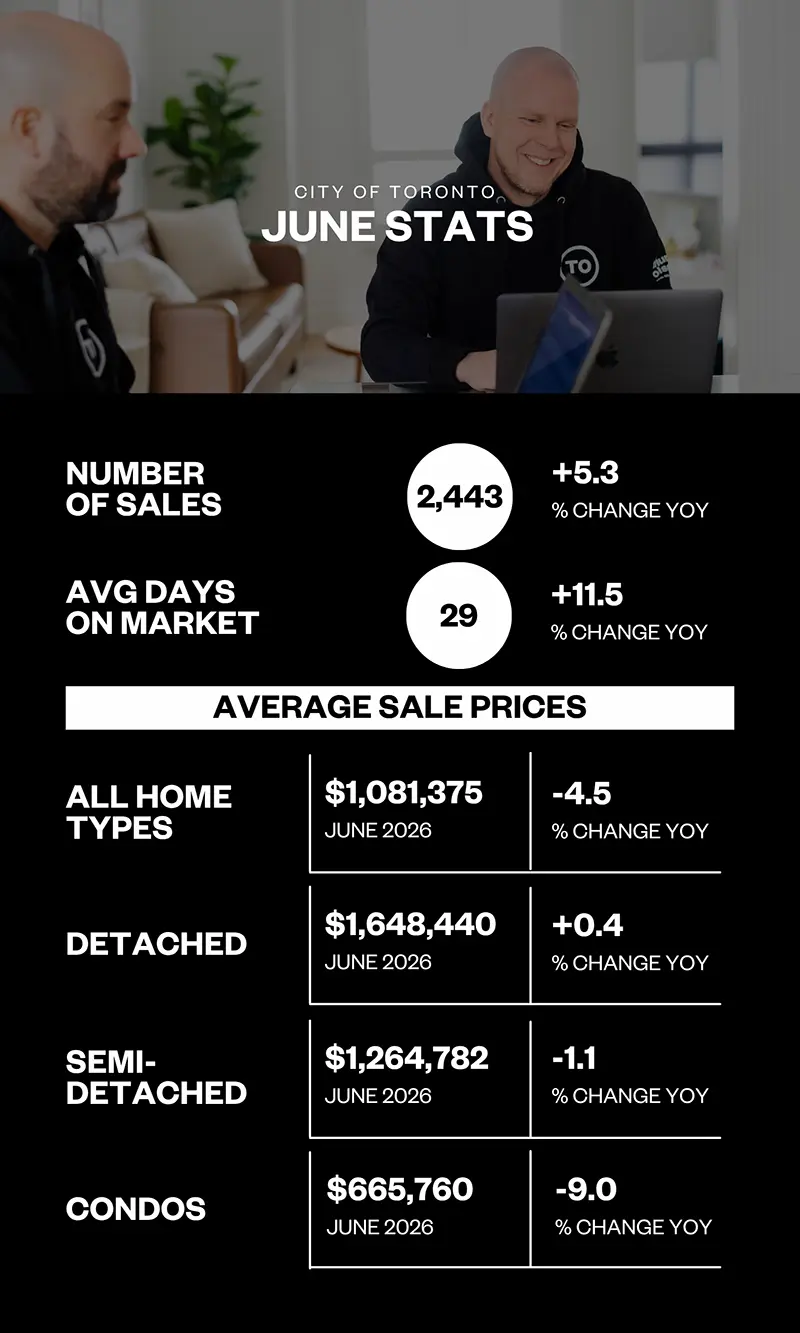
The Toronto housing market continued to build momentum in June, with home sales increasing 5.3% year-over-year while new listings declined by 13.6%. As inventory continues to be absorbed, we’re seeing market conditions gradually tighten across many parts of the city. Buyers still have choice, but in the right neighbourhoods and for well-priced homes, competition is becoming more common.
One trend we’ve noticed firsthand is that the traditional spring market seems to be stretching further into the summer than usual. Rather than activity tapering off as families head to cottages and vacations, many buyers are still actively searching and writing offers. We suspect part of this is due to the slower start to the year, with buyers taking advantage of improved affordability and lower borrowing costs as confidence continues to build.
With that said, it’s important to remember that Toronto isn’t one market. Condos, freeholds, luxury homes, and different neighbourhoods are all behaving a little differently right now. While the condo market continues to offer buyers plenty of choice and negotiating power, well-presented freehold homes in desirable areas are attracting strong interest and selling with confidence.
Overall, the market feels healthier today than it did a few months ago. If this trend continues through the second half of the year, we could see prices stabilize and begin to trend upward as more buyers return to the market and competition increases.
Check out the June year-over-year stats below for more information on the current market.
If you would like statistics specific to your neighbourhood, an updated Comparative Market Analysis for your home, or help deciphering what the numbers could mean for you, please let us know and we would be happy to provide that for you.
Help Us, Help Others!
We’re incredibly thankful for the referrals you send our way. They make up a big part of our business. This year, on top of that usual support, we’re aiming to help 12 additional families with buying or selling in Toronto.
If anyone comes to mind who could use some guidance, we’d be honoured by an introduction. We promise to take great care of them (and make you look good ?).
Have a great month!
Chris and Ford
June 2026 Market Report
June 2026 Newsletter
Thurston Olsen Real Estate Group
Hey Friends!
This month, Toronto finds itself on the world stage as we welcome fans, players, and visitors from across the globe for the FIFA World Cup. Whether you’re a soccer fan or not, it’s hard not to feel the excitement. The city is buzzing, patios are packed, and Toronto is once again getting the chance to show off everything that makes it such a great place to live.
That same energy is showing up in some sectors of the real estate market as well. While we’re not seeing sold-out-stadium levels of competition just yet, more buyers are stepping back into the game, listings are moving, and confidence appears to be building as we head into summer.
What’s particularly interesting right now is that opportunities still exist on both sides of the market. Some neighbourhoods and property types are attracting multiple offers, while others continue to give buyers a little more negotiating room. Much like a World Cup match, success often comes down to timing, positioning, and having the right strategy.
As always, whether you’re buying, selling, investing, or simply keeping an eye on the market, understanding what’s happening at the local level is what matters most.
Here’s your June 2026 Market Update. Let’s kick things off (soccer pun intended)
A New Incentive on the Horizon for New Construction?
One of the more interesting conversations happening in the market right now is around Ontario’s proposed changes to HST on new construction homes.
The province has introduced legislation aimed at expanding HST relief for buyers of newly built homes, with the headline idea being significant savings. potentially up to $130,000 for eligible purchasers of qualifying new builds. The goal is clear: improve affordability and help stimulate new housing supply at a time when both demand and construction activity have been under pressure.
On the surface, this is a meaningful incentive. For buyers, it could reduce the entry cost into brand new housing and potentially shift more demand toward pre-construction and newly completed homes. For builders, it may help improve project viability and unlock stalled developments that have struggled under higher financing and construction costs.
With that said, it’s important to note that this is still a proposal, not fully implemented policy. The final details, timing, and eligibility rules are still being worked through, and until everything is formally in place, there remains some uncertainty around how and when these savings will actually be applied.
As with most policy shifts in real estate, there are two sides to the story. Increased incentives can be a win for buyers, but they can also influence pricing, demand, and how builders structure future launches. In other words, what looks like “savings” on one side of the equation can sometimes be partially absorbed into pricing dynamics on the other.
We’ll be watching this closely over the coming months as more clarity emerges. If you’ve been considering new construction, this is one of those policy changes that may be worth understanding a little earlier rather than later.
As always, we’ll keep you updated as things evolve.
What We Are Seeing From the Field
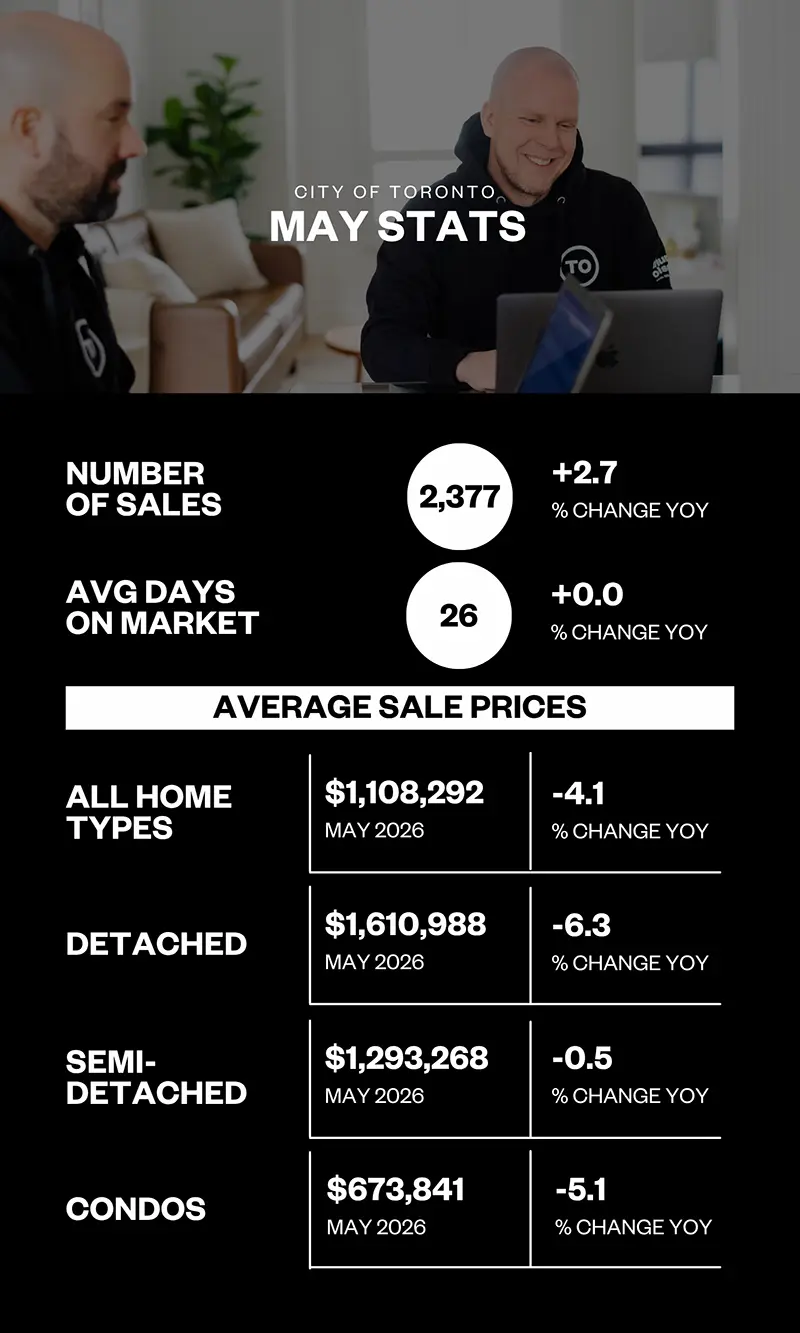
The Toronto resale market tightened in May compared to last year, with sales up year-over-year while new listings declined significantly (down 18%). In simple terms, more buyers are starting to re-enter the market while fewer new listings are coming online, which is gradually shifting conditions back toward a more balanced (and in some pockets, competitive) environment.
Pricing remains softer than last year overall, with benchmark prices still down year-over-year. However, the pace of decline is moderating, and month-over-month data is beginning to show early signs of stabilization.
What’s notable is the direction of travel: inventory is slowly being absorbed, and in certain neighbourhoods, buyers are starting to regain a bit of urgency as selection tightens. While buyers still generally hold negotiating power in many segments, that leverage is less pronounced than it was earlier in the year.
Looking ahead, if sales continue to strengthen relative to new listings, we could see pricing flatten first, followed by gradual upward pressure as we move further into the year.
Check out the May year-over-year stats below for more information on the current market.
If you would like statistics specific to your neighbourhood, an updated Comparative Market Analysis for your home, or help deciphering what the numbers could mean for you, please let us know and we would be happy to provide that for you.
One Great Neighbourhood, Two Fantastic Condo Listings
We’re excited to bring two standout lofts to market right in the HEART of Leslieville.
319 Carlaw Ave – Unit 508 – Work Lofts
A true corner loft in the trendy Work Lofts. If you know Leslieville condos, you know that floor plans like this don’t come up for sale often. This suite blends functionality with modern finishes. Open concept, oversized windows, and a rare wraparound balcony create an incredible sense of light and space. A perfect fit for buyers looking for corner unit living in the heart of Leslieville.
Check out more photos and everything else you need to know at www.319Carlaw.com
233 Carlaw Ave – Unit 406 – Garment Factory Lofts
Set within one of Leslieville’s most sought-after hard loft conversions, this 2-bedroom suite delivers serious character with 11.5-foot ceilings, fluted concrete columns, and polished concrete floors. A fully renovated kitchen, upgraded mechanicals, and a large covered terrace make this a true turnkey loft with style and substance.
Check out more photos and everything else you need to know at www.233Carlaw.com
Help Us, Help Others!
We’re incredibly thankful for the referrals you send our way. They make up a big part of our business. This year, on top of that usual support, we’re aiming to help 12 additional families with buying or selling in Toronto.
If anyone comes to mind who could use some guidance, we’d be honoured by an introduction. We promise to take great care of them (and make you look good).
Have a great month!
Chris and Ford
June 2026 Market Report
June 2026 Newsletter
Thurston Olsen Real Estate Group
Hey Friends!
This month, Toronto finds itself on the world stage as we welcome fans, players, and visitors from across the globe for the FIFA World Cup. Whether you’re a soccer fan or not, it’s hard not to feel the excitement. The city is buzzing, patios are packed, and Toronto is once again getting the chance to show off everything that makes it such a great place to live.
That same energy is showing up in some sectors of the real estate market as well. While we’re not seeing sold-out-stadium levels of competition just yet, more buyers are stepping back into the game, listings are moving, and confidence appears to be building as we head into summer.
What’s particularly interesting right now is that opportunities still exist on both sides of the market. Some neighbourhoods and property types are attracting multiple offers, while others continue to give buyers a little more negotiating room. Much like a World Cup match, success often comes down to timing, positioning, and having the right strategy.
As always, whether you’re buying, selling, investing, or simply keeping an eye on the market, understanding what’s happening at the local level is what matters most.
Here’s your June 2026 Market Update. Let’s kick things off (soccer pun intended)
A New Incentive on the Horizon for New Construction?
One of the more interesting conversations happening in the market right now is around Ontario’s proposed changes to HST on new construction homes.
The province has introduced legislation aimed at expanding HST relief for buyers of newly built homes, with the headline idea being significant savings. potentially up to $130,000 for eligible purchasers of qualifying new builds. The goal is clear: improve affordability and help stimulate new housing supply at a time when both demand and construction activity have been under pressure.
On the surface, this is a meaningful incentive. For buyers, it could reduce the entry cost into brand new housing and potentially shift more demand toward pre-construction and newly completed homes. For builders, it may help improve project viability and unlock stalled developments that have struggled under higher financing and construction costs.
With that said, it’s important to note that this is still a proposal, not fully implemented policy. The final details, timing, and eligibility rules are still being worked through, and until everything is formally in place, there remains some uncertainty around how and when these savings will actually be applied.
As with most policy shifts in real estate, there are two sides to the story. Increased incentives can be a win for buyers, but they can also influence pricing, demand, and how builders structure future launches. In other words, what looks like “savings” on one side of the equation can sometimes be partially absorbed into pricing dynamics on the other.
We’ll be watching this closely over the coming months as more clarity emerges. If you’ve been considering new construction, this is one of those policy changes that may be worth understanding a little earlier rather than later.
As always, we’ll keep you updated as things evolve.
What We Are Seeing From the Field
The Toronto resale market tightened in May compared to last year, with sales up year-over-year while new listings declined significantly (down 18%). In simple terms, more buyers are starting to re-enter the market while fewer new listings are coming online, which is gradually shifting conditions back toward a more balanced (and in some pockets, competitive) environment.
Pricing remains softer than last year overall, with benchmark prices still down year-over-year. However, the pace of decline is moderating, and month-over-month data is beginning to show early signs of stabilization.
What’s notable is the direction of travel: inventory is slowly being absorbed, and in certain neighbourhoods, buyers are starting to regain a bit of urgency as selection tightens. While buyers still generally hold negotiating power in many segments, that leverage is less pronounced than it was earlier in the year.
Looking ahead, if sales continue to strengthen relative to new listings, we could see pricing flatten first, followed by gradual upward pressure as we move further into the year.
Check out the May year-over-year stats below for more information on the current market.
If you would like statistics specific to your neighbourhood, an updated Comparative Market Analysis for your home, or help deciphering what the numbers could mean for you, please let us know and we would be happy to provide that for you.
One Great Neighbourhood, Two Fantastic Condo Listings
We’re excited to bring two standout lofts to market right in the HEART of Leslieville.
319 Carlaw Ave – Unit 508 – Work Lofts
A true corner loft in the trendy Work Lofts. If you know Leslieville condos, you know that floor plans like this don’t come up for sale often. This suite blends functionality with modern finishes. Open concept, oversized windows, and a rare wraparound balcony create an incredible sense of light and space. A perfect fit for buyers looking for corner unit living in the heart of Leslieville.
Check out more photos and everything else you need to know at www.319Carlaw.com
233 Carlaw Ave – Unit 406 – Garment Factory Lofts
Set within one of Leslieville’s most sought-after hard loft conversions, this 2-bedroom suite delivers serious character with 11.5-foot ceilings, fluted concrete columns, and polished concrete floors. A fully renovated kitchen, upgraded mechanicals, and a large covered terrace make this a true turnkey loft with style and substance.
Check out more photos and everything else you need to know at www.233Carlaw.com
Help Us, Help Others!
We’re incredibly thankful for the referrals you send our way. They make up a big part of our business. This year, on top of that usual support, we’re aiming to help 12 additional families with buying or selling in Toronto.
If anyone comes to mind who could use some guidance, we’d be honoured by an introduction. We promise to take great care of them (and make you look good).
Have a great month!
Chris and Ford
May 2026 Market Report
May 2026 Newsletter
Thurston Olsen Real Estate Group
Hey Friends!
Spring has officially arrived in Toronto, and with the nicer weather, you can feel the market starting to come back to life. More buyers are stepping out, listings are picking up, and that familiar spring energy is building again across the city.
What’s interesting right now is how different pockets of the market are creating opportunities in different ways. Some neighbourhoods and property types are seeing competition ramp back up, while others are still giving buyers a bit more room to breathe. It’s not one-size-fits-all, and that’s actually where the opportunity lies.
Think of it like patio season – Some spots are already buzzing, others you can still walk right into and grab a great table. The key is knowing where to look.
With momentum building and conditions starting to tighten, this is the kind of market where a smart plan can really pay off, whether you’re buying, selling, or just keeping a close eye on things.
Here’s your May 2026 Market Update. Let’s dive in.
The “Bank of Mom & Dad” Is Reshaping the Market
There’s a massive wave of wealth moving through Canada right now, and it’s starting to leave a real mark on the housing market. Experts estimate that over $1 trillion will be passed down from baby boomers to younger generations between 2023 and 2026, with a significant portion coming from real estate gains.
Here in Toronto, we’re seeing this play out in real time. More buyers (especially first-timers) are getting a financial boost from family, whether it’s help with a down payment or early inheritance. In fact, nearly 1 in 3 first-time buyers recently received support, with average gifts now north of $100K. That kind of backing can be the difference between sitting on the sidelines and actually getting into the market.
From a market perspective, it’s quietly adding fuel to demand. Buyers with support can act faster, compete more aggressively, and stretch a little further on price, particularly in entry-level and family-friendly segments. At the same time, it’s creating a wider gap between those who have access to that help and those navigating things on their own. And that’s where it gets interesting. This isn’t just a financial trend – it’s starting to shape who’s able to participate in the market, how competition plays out, and even what “affordability” looks like from one buyer to the next.
It raises a bigger question: how much is family support influencing today’s market, and where does that leave buyers going it alone?
We’re always curious what you’re seeing out there. Are more buyers in your circle getting a boost from family, or are you noticing the pressure from the other side of the table? Are you considering giving your children an early inheritance so that they can get into the market?
We’d love to hear from you!
What We Are Seeing From the Field
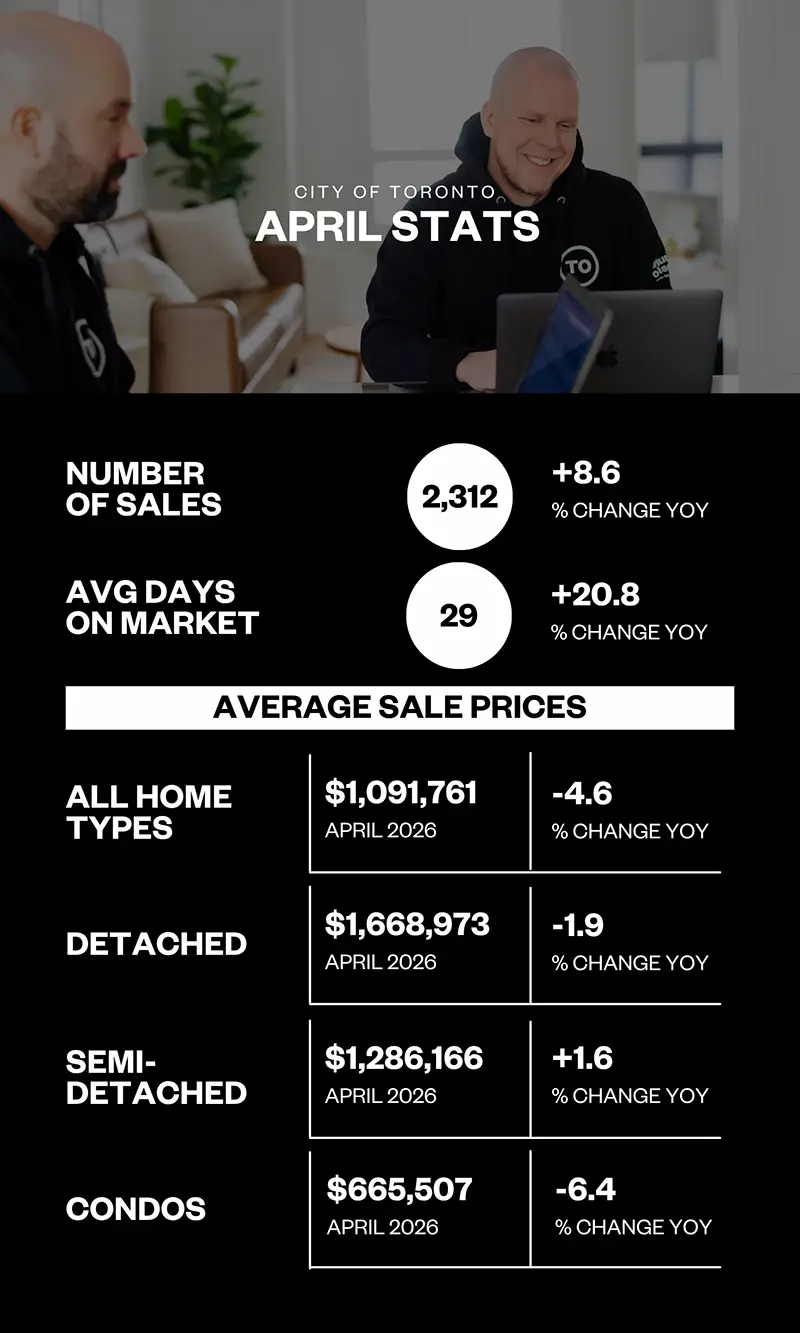
April brought a subtle but important shift in the GTA housing market. Sales were up 8.6% year-over-year, with 2,312 homes trading hands, while new listings dropped by 13.6%, pointing to a market that’s beginning to tighten as we move through the spring season.
Even with improving activity, buyers are still benefiting from relatively softer pricing, with the average home price sitting at $1,091,761, down 4.6% from last year.
With that said, prices have started to stabilize on a month-over-month basis, suggesting the window of opportunity may not stay open for much longer.
Lower borrowing costs and improved affordability have brought more buyers back into the market, but there’s still a significant amount of pent-up demand waiting on the sidelines. If listings remain constrained and confidence continues to build, we could see competition increase in the coming months, particularly for well-priced homes in desirable neighbourhoods.
Check out the April year-over-year stats below for more information on the current market.
If you would like statistics specific to your neighbourhood, an updated Comparative Market Analysis for your home, or help deciphering what the numbers could mean for you, please let us know and we would be happy to provide that for you.
Help Us, Help Others!
We’re incredibly thankful for the referrals you send our way. They make up a big part of our business. This year, on top of that usual support, we’re aiming to help 12 additional families with buying or selling in Toronto.
If anyone comes to mind who could use some guidance, we’d be honoured by an introduction. We promise to take great care of them (and make you look good.
Have a great month!
Chris and Ford