
March 2026 Market Report

March 2026 Newsletter
Thurston Olsen Real Estate Group
Hey Friends!
March is when the Toronto market really starts to stretch its legs. The quiet pause of January fades, new listings begin to pop up, and buyers who spent the winter “just watching” suddenly start stepping into the game. You can almost feel the energy shifting across Toronto as we move closer to the spring market.
It’s also the time of year when some of the bigger conversations about housing in Toronto start bubbling up again. Development is one of them. Some people welcome the cranes on the skyline as a sign that our growing city is creating more homes. Others worry about the impact on neighbourhood character, traffic, and years of construction disruption. Like most things in real estate, there are thoughtful arguments on both sides.
What we do know is this: demand for housing in Toronto isn’t going anywhere. As the market slowly builds momentum, strategy, timing, and preparation are becoming more important than ever for buyers and sellers looking to make smart moves this year.
Here’s your March 2026 Market Update. Let’s dive in.
Toronto Development: Progress or Pain?
If you’ve lived in Toronto for more than five minutes, you’ve probably had this conversation.
“Why are they building another condo here?”
Or…
“Where else are people supposed to live?”
The truth? Both sides have valid points.
The Case For Development
Toronto continues to grow. New families, newcomers, young professionals, downsizers, and they all need housing. Without new supply, prices can climb quickly, making it harder for the next generation to put down roots.
New development can also bring:
- Increased housing options (condos, purpose-built rentals, townhomes)
- Revitalized streetscapes and infrastructure upgrades
- New retail, restaurants, and amenities
- Long-term property value growth in evolving neighbourhoods
Growth, when done well, can mean vibrancy. Think improved transit, better walkability, and more complete communities. Cities either grow… or they slowly fade. Toronto clearly isn’t choosing the second option.
The Case Against Development
On the flip side, change isn’t always comfortable.
Residents often worry about:
- Increased traffic and congestion
- Strain on schools, parks, and transit
- Years of construction noise and disruption
- Loss of neighbourhood character
For homeowners who moved in for tree-lined streets and a certain “feel,” a 40-storey tower next door can feel like a shock to the system. Development can sometimes outpace infrastructure planning, which is where frustration tends to boil over.
The Real Conversation
This isn’t really about “pro” versus “anti” development. It’s about balance.
How do we add housing without overwhelming communities?
How do we protect neighbourhood character while still making room for the next generation?
How do we plan smarter so infrastructure keeps up with growth?
Toronto’s challenge isn’t whether to grow, it’s how to grow well.
And whether you love cranes on the skyline or wish they’d take a holiday, the reality is that development will continue shaping our city. The key is thoughtful planning, strong community input, and policies that aim for long-term livability.
So… Where Do You Stand?
Are you in the “build more homes yesterday” camp?
Or the “let’s protect the neighbourhood feel” camp?
Maybe you’re somewhere in the middle – supportive of growth, but only if it’s done thoughtfully.
We’d genuinely love to hear your take.
Hit reply and let us know:
- Is there a development near you that you’re excited about?
- Or one that makes you shake your head every time you drive by?
- Do you think Toronto is growing the right way?
These conversations matter. Development impacts property values, rental demand, neighbourhood character, and long-term investment potential….whether we’re talking about a condo downtown or a family home in the core.
Your perspective helps us better understand what local families are thinking, which ultimately helps us serve you (and others) at a higher level.
Looking forward to hearing your thoughts, we read every reply.
What We Are Seeing From the Field
The latest numbers from Toronto Regional Real Estate Board suggest the market is tightening, but maybe not in the way many people expected.
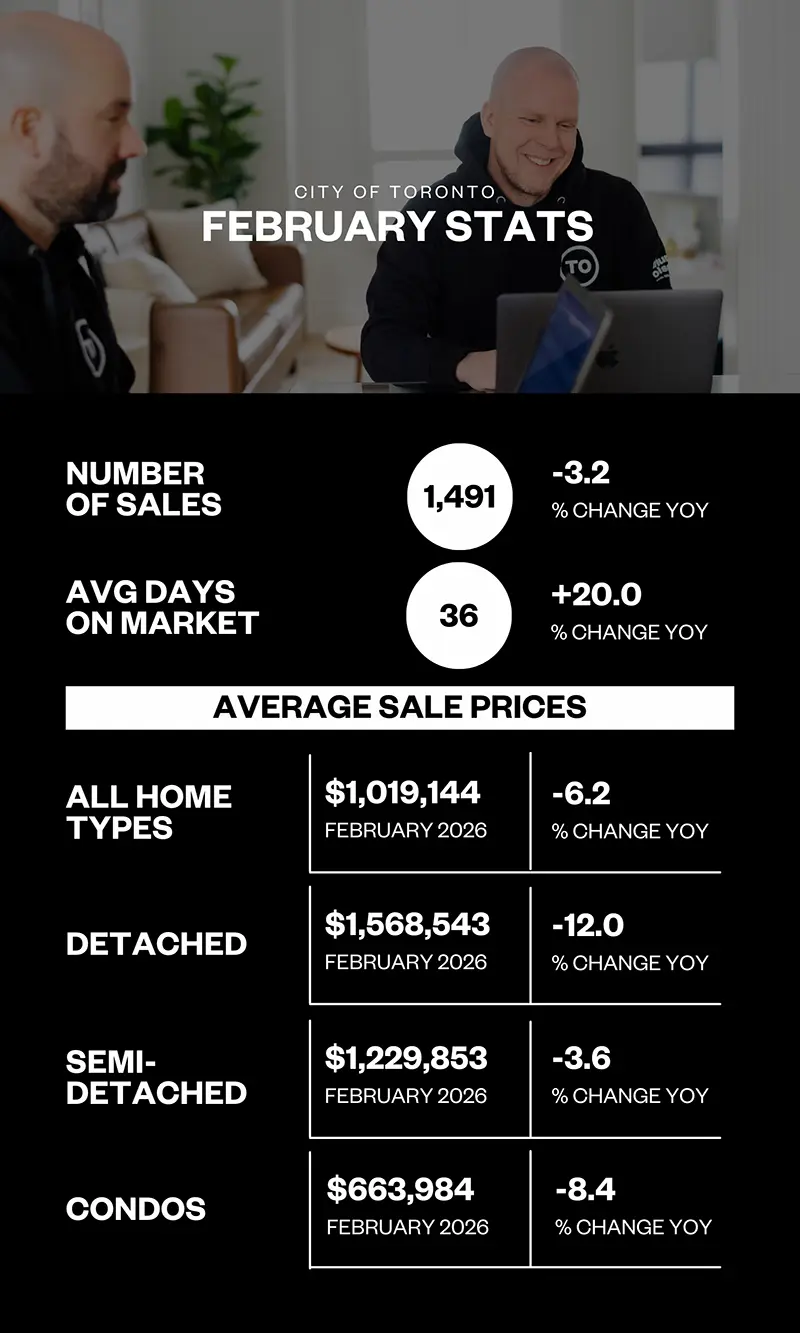
In February, there were 1,491 home sales across Toronto, about 3% lower than this time last year. At first glance that might sound like the market is slowing, but the bigger story is actually happening on the supply side.
New listings dropped roughly 13% year-over-year, meaning fewer homes are coming to market. When listings fall faster than sales, it naturally starts tightening conditions and can increase competition among buyers over time.
Right now, many buyers appear to be taking a “wait and see” approach – watching prices closely and hoping for stability before jumping in. At the same time, industry estimates suggest more than 100,000 potential buyers are sitting on the sidelines, waiting for the right moment.
Prices have adjusted over the past year as well. The average Toronto home price in February was $1,019,144, roughly 6% lower than a year ago.
What does this mean in practical terms?
If listing inventory continues to remain tight heading into the spring market, the combination of limited supply and pent-up buyer demand could bring more competition back into the market, particularly in desirable neighbourhoods.
In other words: the spring market may end up being less about how many buyers are out there and more about how many homes actually come up for sale.
Check out the February year-over-year stats below for more information on the current market.
If you would like statistics specific to your neighbourhood, an updated Comparative Market Analysis for your home, or help deciphering what the numbers could mean for you, please let us know and we would be happy to provide that for you.
Help Us, Help Others!
We’re incredibly thankful for the referrals you send our way. They make up a big part of our business. This year, on top of that usual support, we’re aiming to help 12 additional families with buying or selling in Toronto.
If anyone comes to mind who could use some guidance, we’d be honoured by an introduction. We promise to take great care of them (and make you look good.
Have a great month!
Chris and Ford
February 2026 Market Report
February 2026 Newsletter
Thurston Olsen Real Estate Group
Hey Friends!
February is when the market starts to wake up. The initial pause of the new year is behind us, conversations are getting more serious, and we’re seeing early signs of activity from buyers and sellers who are planning ahead for spring.
We’re heading into the rest of 2026 feeling encouraged by the momentum building across the city, and grateful for the trust and conversations we continue to have with so many of you. Whether it’s long-term planning, early prep, or just keeping a close eye on the numbers, this is a month where clarity really matters.
The Toronto market is offering opportunities for those paying attention. Strategy, timing, and preparation are becoming increasingly important as confidence slowly builds.
Here’s your February 2026 Market Update. Let’s keep moving forward with clarity and confidence.
Has Home Ownership In Toronto Become More Affordable?
Since the start of 2024, we’ve seen something Toronto buyers haven’t enjoyed in a while: prices and mortgage rates moving in the right direction at the same time. Average home prices are meaningfully lower than their peak, and mortgage rates have come down from the highs we were dealing with just a couple of years ago.
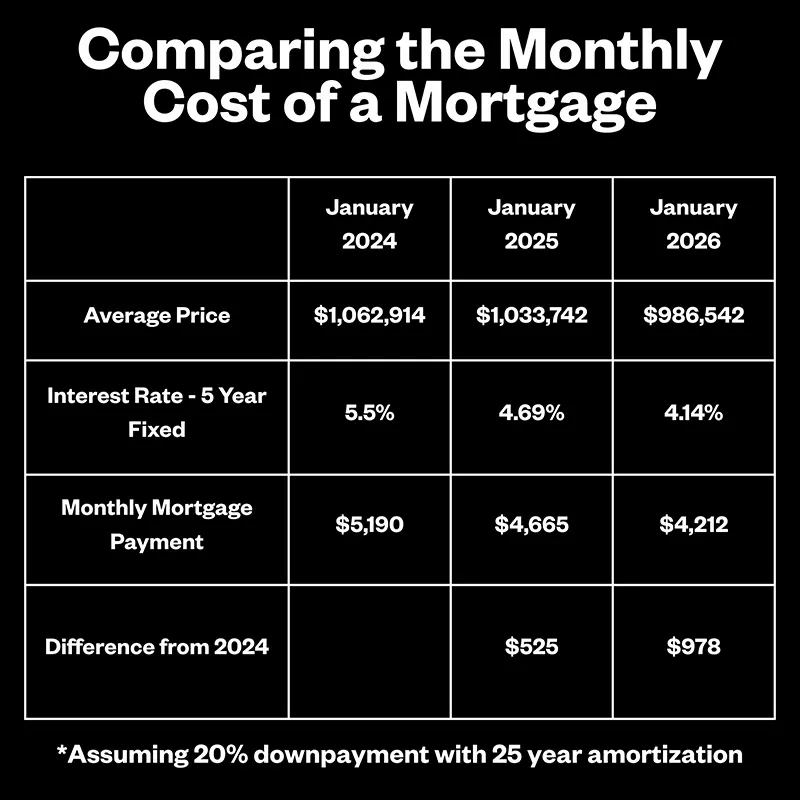
The average home price has dropped from about $1.06M in 2024 to just under $987K in early 2026, while 5-year fixed mortgage rates have eased from 5.5% down to roughly 4.14%. When those two forces work together, monthly payments shrink in a meaningful way.
Here’s the real-world impact:
A typical monthly mortgage payment has fallen from about $5,190 in January 2024 to roughly $4,212 today. That’s nearly $1,000 per month less than what buyers were facing just two years ago, and about $525/month cheaper than January 2025.
That’s not pocket change. That’s daycare money, investment money, or “still enjoying life while owning a home” money.
Now, we recognize that the cost of living in other areas of life may have increased, but at least the cost of home ownership has improved – a highly debated topic that has been at the top of people’s complaint lists for many recent years!
What We Are Seeing From the Field
At a headline level, the market looks calmer than this time last year. Sales are down, average prices are softer, and the pace feels more measured overall. But zoom in, and the story changes quickly.
In well-priced, well-prepared homes, we’re still seeing, in some cases, multiple offers, bully offers, packed showings, and sales well above the asking price. On the other hand, homes that entered the market without a clear strategy are sitting longer, offer nights come and go, and some listings are quietly being re-listed after missing the mark.
This creates a uniquely opportunistic market. Buyers who are prepared and decisive can find real leverage in quieter segments, while sellers who invest in preparation can still generate strong competition and premium results. In today’s market, strong pricing, preparation, and marketing are what separate Sold from Stalled.
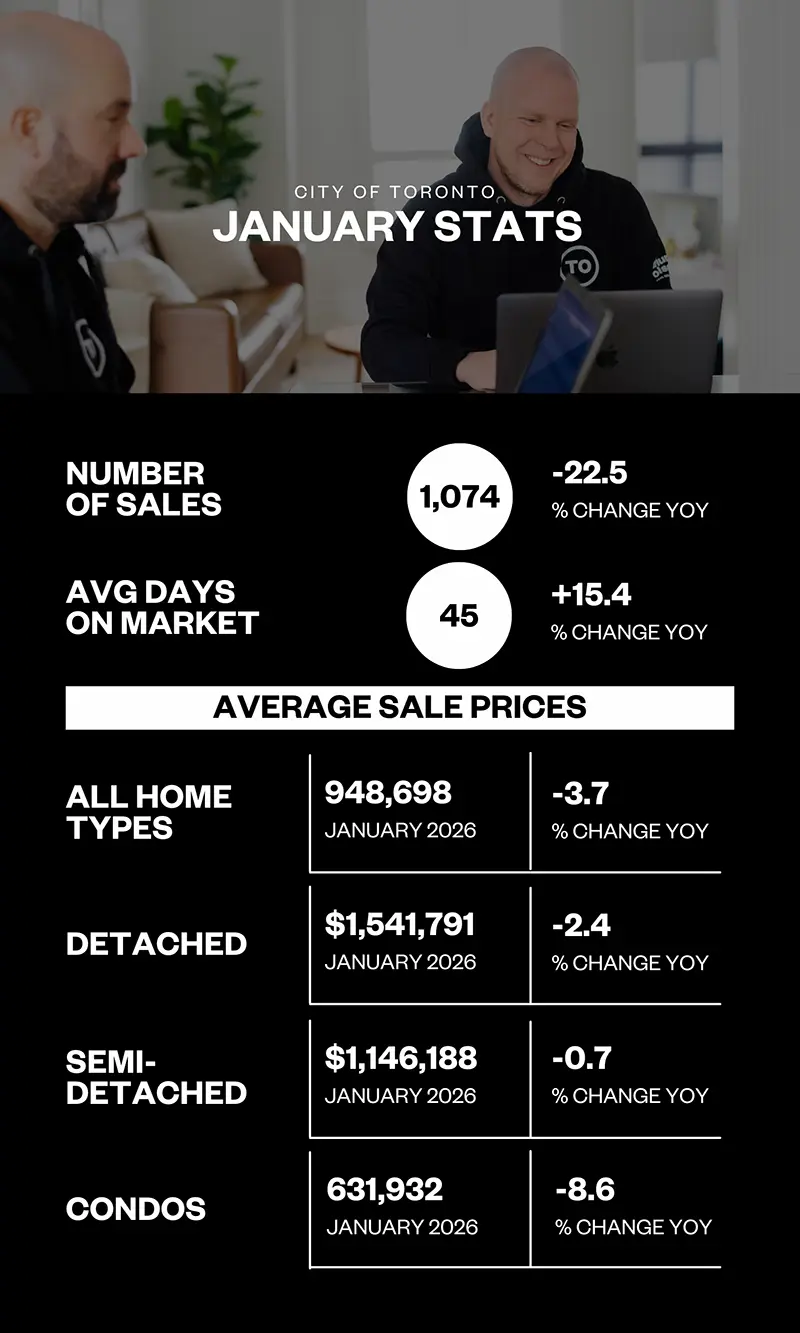
Check out the January year-over-year stats below for more information on the current market.
If you would like statistics specific to your neighbourhood, an updated Comparative Market Analysis for your home, or help deciphering what the numbers could mean for you, please let us know and we would be happy to provide that for you.
Vacant Home Tax – Don’t Forget To Declare!
(Yes, We Have To Do This Every Year)
Toronto homeowners, it’s that time of year again! The Vacant Home Tax (VHT) declaration deadline is fast approaching, and even if you live in your home, you still need to file (don’t forget any rental properties)!
Failing to make the declaration by April 30th could result in penalties or even having your home mistakenly classified as vacant, leading to an unexpected tax bill. Yikes!
The tax is now 3% of your current assessed tax value, so if your home was assessed at $800,000 you could be on the hook for $24,000 in tax!
*Keep in mind that MPAC generally uses an assessed value much lower than what your home is actually worth – this info should be on your final tax bill.
Not sure how to complete your declaration? No worries, we’ve got your back! Whether you need a quick rundown on the process or have questions about potential exemptions, reach out anytime, and let’s make sure you avoid any unnecessary surprises.
Help Us, Help Others!
We’re incredibly thankful for the referrals you send our way. They make up a big part of our business. This year, on top of that usual support, we’re aiming to help 12 additional families with buying or selling in Toronto.
If anyone comes to mind who could use some guidance, we’d be honoured by an introduction. We promise to take great care of them (and make you look good ?).
Have a great month!
Chris and Ford
March 2026 Market Report
March 2026 Newsletter
Thurston Olsen Real Estate Group
Hey Friends!
March is when the Toronto market really starts to stretch its legs. The quiet pause of January fades, new listings begin to pop up, and buyers who spent the winter “just watching” suddenly start stepping into the game. You can almost feel the energy shifting across Toronto as we move closer to the spring market.
It’s also the time of year when some of the bigger conversations about housing in Toronto start bubbling up again. Development is one of them. Some people welcome the cranes on the skyline as a sign that our growing city is creating more homes. Others worry about the impact on neighbourhood character, traffic, and years of construction disruption. Like most things in real estate, there are thoughtful arguments on both sides.
What we do know is this: demand for housing in Toronto isn’t going anywhere. As the market slowly builds momentum, strategy, timing, and preparation are becoming more important than ever for buyers and sellers looking to make smart moves this year.
Here’s your March 2026 Market Update. Let’s dive in.
Toronto Development: Progress or Pain?
If you’ve lived in Toronto for more than five minutes, you’ve probably had this conversation.
“Why are they building another condo here?”
Or…
“Where else are people supposed to live?”
The truth? Both sides have valid points.
The Case For Development
Toronto continues to grow. New families, newcomers, young professionals, downsizers, and they all need housing. Without new supply, prices can climb quickly, making it harder for the next generation to put down roots.
New development can also bring:
- Increased housing options (condos, purpose-built rentals, townhomes)
- Revitalized streetscapes and infrastructure upgrades
- New retail, restaurants, and amenities
- Long-term property value growth in evolving neighbourhoods
Growth, when done well, can mean vibrancy. Think improved transit, better walkability, and more complete communities. Cities either grow… or they slowly fade. Toronto clearly isn’t choosing the second option.
The Case Against Development
On the flip side, change isn’t always comfortable.
Residents often worry about:
- Increased traffic and congestion
- Strain on schools, parks, and transit
- Years of construction noise and disruption
- Loss of neighbourhood character
For homeowners who moved in for tree-lined streets and a certain “feel,” a 40-storey tower next door can feel like a shock to the system. Development can sometimes outpace infrastructure planning, which is where frustration tends to boil over.
The Real Conversation
This isn’t really about “pro” versus “anti” development. It’s about balance.
How do we add housing without overwhelming communities?
How do we protect neighbourhood character while still making room for the next generation?
How do we plan smarter so infrastructure keeps up with growth?
Toronto’s challenge isn’t whether to grow, it’s how to grow well.
And whether you love cranes on the skyline or wish they’d take a holiday, the reality is that development will continue shaping our city. The key is thoughtful planning, strong community input, and policies that aim for long-term livability.
So… Where Do You Stand?
Are you in the “build more homes yesterday” camp?
Or the “let’s protect the neighbourhood feel” camp?
Maybe you’re somewhere in the middle – supportive of growth, but only if it’s done thoughtfully.
We’d genuinely love to hear your take.
Hit reply and let us know:
- Is there a development near you that you’re excited about?
- Or one that makes you shake your head every time you drive by?
- Do you think Toronto is growing the right way?
These conversations matter. Development impacts property values, rental demand, neighbourhood character, and long-term investment potential….whether we’re talking about a condo downtown or a family home in the core.
Your perspective helps us better understand what local families are thinking, which ultimately helps us serve you (and others) at a higher level.
Looking forward to hearing your thoughts, we read every reply.
What We Are Seeing From the Field
The latest numbers from Toronto Regional Real Estate Board suggest the market is tightening, but maybe not in the way many people expected.
In February, there were 1,491 home sales across Toronto, about 3% lower than this time last year. At first glance that might sound like the market is slowing, but the bigger story is actually happening on the supply side.
New listings dropped roughly 13% year-over-year, meaning fewer homes are coming to market. When listings fall faster than sales, it naturally starts tightening conditions and can increase competition among buyers over time.
Right now, many buyers appear to be taking a “wait and see” approach – watching prices closely and hoping for stability before jumping in. At the same time, industry estimates suggest more than 100,000 potential buyers are sitting on the sidelines, waiting for the right moment.
Prices have adjusted over the past year as well. The average Toronto home price in February was $1,019,144, roughly 6% lower than a year ago.
What does this mean in practical terms?
If listing inventory continues to remain tight heading into the spring market, the combination of limited supply and pent-up buyer demand could bring more competition back into the market, particularly in desirable neighbourhoods.
In other words: the spring market may end up being less about how many buyers are out there and more about how many homes actually come up for sale.
Check out the February year-over-year stats below for more information on the current market.
If you would like statistics specific to your neighbourhood, an updated Comparative Market Analysis for your home, or help deciphering what the numbers could mean for you, please let us know and we would be happy to provide that for you.
Help Us, Help Others!
We’re incredibly thankful for the referrals you send our way. They make up a big part of our business. This year, on top of that usual support, we’re aiming to help 12 additional families with buying or selling in Toronto.
If anyone comes to mind who could use some guidance, we’d be honoured by an introduction. We promise to take great care of them (and make you look good.
Have a great month!
Chris and Ford
February 2026 Market Report
February 2026 Newsletter
Thurston Olsen Real Estate Group
Hey Friends!
February is when the market starts to wake up. The initial pause of the new year is behind us, conversations are getting more serious, and we’re seeing early signs of activity from buyers and sellers who are planning ahead for spring.
We’re heading into the rest of 2026 feeling encouraged by the momentum building across the city, and grateful for the trust and conversations we continue to have with so many of you. Whether it’s long-term planning, early prep, or just keeping a close eye on the numbers, this is a month where clarity really matters.
The Toronto market is offering opportunities for those paying attention. Strategy, timing, and preparation are becoming increasingly important as confidence slowly builds.
Here’s your February 2026 Market Update. Let’s keep moving forward with clarity and confidence.
Has Home Ownership In Toronto Become More Affordable?
Since the start of 2024, we’ve seen something Toronto buyers haven’t enjoyed in a while: prices and mortgage rates moving in the right direction at the same time. Average home prices are meaningfully lower than their peak, and mortgage rates have come down from the highs we were dealing with just a couple of years ago.
The average home price has dropped from about $1.06M in 2024 to just under $987K in early 2026, while 5-year fixed mortgage rates have eased from 5.5% down to roughly 4.14%. When those two forces work together, monthly payments shrink in a meaningful way.
Here’s the real-world impact:
A typical monthly mortgage payment has fallen from about $5,190 in January 2024 to roughly $4,212 today. That’s nearly $1,000 per month less than what buyers were facing just two years ago, and about $525/month cheaper than January 2025.
That’s not pocket change. That’s daycare money, investment money, or “still enjoying life while owning a home” money.
Now, we recognize that the cost of living in other areas of life may have increased, but at least the cost of home ownership has improved – a highly debated topic that has been at the top of people’s complaint lists for many recent years!
What We Are Seeing From the Field
At a headline level, the market looks calmer than this time last year. Sales are down, average prices are softer, and the pace feels more measured overall. But zoom in, and the story changes quickly.
In well-priced, well-prepared homes, we’re still seeing, in some cases, multiple offers, bully offers, packed showings, and sales well above the asking price. On the other hand, homes that entered the market without a clear strategy are sitting longer, offer nights come and go, and some listings are quietly being re-listed after missing the mark.
This creates a uniquely opportunistic market. Buyers who are prepared and decisive can find real leverage in quieter segments, while sellers who invest in preparation can still generate strong competition and premium results. In today’s market, strong pricing, preparation, and marketing are what separate Sold from Stalled.
Check out the January year-over-year stats below for more information on the current market.
If you would like statistics specific to your neighbourhood, an updated Comparative Market Analysis for your home, or help deciphering what the numbers could mean for you, please let us know and we would be happy to provide that for you.
Vacant Home Tax – Don’t Forget To Declare!
(Yes, We Have To Do This Every Year)
Toronto homeowners, it’s that time of year again! The Vacant Home Tax (VHT) declaration deadline is fast approaching, and even if you live in your home, you still need to file (don’t forget any rental properties)!
Failing to make the declaration by April 30th could result in penalties or even having your home mistakenly classified as vacant, leading to an unexpected tax bill. Yikes!
The tax is now 3% of your current assessed tax value, so if your home was assessed at $800,000 you could be on the hook for $24,000 in tax!
*Keep in mind that MPAC generally uses an assessed value much lower than what your home is actually worth – this info should be on your final tax bill.
Not sure how to complete your declaration? No worries, we’ve got your back! Whether you need a quick rundown on the process or have questions about potential exemptions, reach out anytime, and let’s make sure you avoid any unnecessary surprises.
Help Us, Help Others!
We’re incredibly thankful for the referrals you send our way. They make up a big part of our business. This year, on top of that usual support, we’re aiming to help 12 additional families with buying or selling in Toronto.
If anyone comes to mind who could use some guidance, we’d be honoured by an introduction. We promise to take great care of them (and make you look good ?).
Have a great month!
Chris and Ford